Almost every one of our best client relationships started the same way: with a phone call about a leak. A stain on a top-floor ceiling, a puddle in a stairwell, water running down the inside of a window after a nor’easter. Someone needs it to stop, and they need it to stop now.
We love those calls. Finding where water is getting in and why is some of the most satisfying work we do. But if we’re honest, the leak call is the worst possible time to be making decisions about a building. Budgets are already set, tenants or residents are frustrated, and every option on the table is priced as an emergency.
The relationship we actually want with our clients is a different one. We want to be the people you call in the fall to talk about next year’s capital budget, not the people you call at 2 a.m. in March. The good news is that the path from one to the other is shorter than most owners think, and it usually starts with that very first leak.
A Leak Is Rarely Just a Leak
Water is honest. It goes where the building lets it go, and when it shows up inside, it is telling you something about a system, not just a spot. A failed sealant joint at one window is almost never the only failed joint; it is the first one to show, on a building where every joint was installed the same year, by the same crew, with the same product. A clogged roof drain may point to a roof that was never sloped properly to begin with. Efflorescence at a parapet can be the earliest visible sign of a masonry wall that has been taking on water for a decade.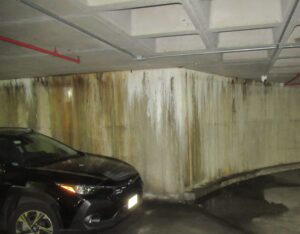
That is why a good leak investigation never stops at the stain. We are asking two questions at once: where is the water getting in today, and what does that tell us about the rest of the building? On a single building, the answer to the second question shapes the repair. On a campus, a portfolio, or a co-op with several buildings of the same vintage, it shapes the next five to ten years.
Owners and managers already sense this. The phrase we hear most often after a leak is fixed is some version of “So what else should I be worried about?” That question is the doorway to capital planning.
From One Leak to a Campus Plan
Picture a property manager responsible for four mid-rise residential buildings and a shared parking garage, all built within a few years of each other. Water shows up at a fourth-floor window in Building B. Here is how that call can grow into a plan for the whole property.
- Stop the water and find the source. We investigate the leak itself: visual review, probing, and water testing where needed to confirm the actual entry point rather than guessing. The goal of this step is simple, a targeted repair that works.
- Read what the leak is telling us. Say the source is deteriorated perimeter sealant and a poorly lapped sill flashing. If that detail failed at one window, it was likely built the same way at every window in Building B, and probably in Buildings A, C and D as well.
- Widen the lens. Instead of waiting for the next three leaks, we walk the rest of the property: roofs, façades, windows, sealants, balconies, and the garage deck. This is a condition assessment, scaled to the property. It does not need to be exhaustive to be useful.
- Rank what we find. Every item gets sorted by urgency: safety and active damage now, items that will become problems in the next one to two years, planned work in years three to five, and things to simply watch. Each gets an order-of-magnitude cost.
- Sequence it into years. This is where the real value shows up. We bundle work that shares access, so the same scaffold or lift serves the sealant replacement and the masonry repointing. We line up design in the fall with construction in the spring. We align with the inspection cycles the property already has to meet, such as FISP in New York, the Boston Façade Ordinance, or parking garage inspections under Local Law 126.
- Revisit it every year. A capital plan is a living document. An annual walkthrough confirms what was completed, catches anything new, and adjusts the next year’s budget before it is due.
For our hypothetical property, the result might look something like this:
| Year | Building | Work | Why now |
| 1 | B | Window perimeter sealant and sill flashing repairs | Active leaks; source confirmed by testing |
| 1 | Garage | Localized concrete repairs and drain cleaning | Spalling over parked cars; safety item |
| 2 | A and C | Window sealant replacement | Same detail and age as Building B |
| 2 | Garage | Traffic coating at drive aisles | Protects the Year 1 repairs and slows corrosion |
| 3 | All | Roof replacement design for A; maintenance on B, C, D | A is nearing the end of its service life |
| 4 | A | Roof replacement | Designed in the fall of Year 3, bid over winter |
| 5 | D | Window sealant and parapet repointing, one scaffold | Bundled access lowers mobilization cost |
None of that is exotic. It is the same engineering judgment that went into the original leak investigation, applied to the whole property and laid out on a calendar.
Why This Is Better for Owners and Managers
The case for capital planning is not that engineers like spreadsheets. It is that reactive maintenance is the most expensive way to own a building.
- Predictable budgets. A five-year plan turns surprises into line items. For co-op and condo boards, that can be the difference between a planned reserve contribution and an unplanned special assessment.
- Better pricing. Emergency work is priced as emergency work. Planned projects can be designed in the off-season, bid competitively over the winter, and scheduled when contractors have capacity.
- Fewer mobilizations. Scaffolding, lifts, swing stages and protection are a large share of envelope project costs. Bundling work that shares access means paying for it once instead of three times.
- Longer service life. Small, timely repairs, like a sealant joint or a traffic coating, protect the much larger investments behind them, like the masonry, the window frames, or the reinforcing steel in a garage slab.
- Credibility with stakeholders. A documented plan gives managers something concrete to show owners, boards, lenders and insurers. It shows the building is being cared for on purpose, not by accident.
- Compliance without panic. When required inspections are built into the plan, the report findings land in a budget that already expected them.
To be fair, not every leak needs to become a campus plan. A single building with a one-off flashing failure from a recent rooftop unit installation may just need the repair, and we will tell you that. But where buildings share an age, a construction type or a history of deferred maintenance, the first leak is rarely the last one.
The Duffy Difference
Plenty of firms can produce a capital plan. What makes one useful is whether the people behind it understand your buildings and your constraints. That is where our four core values, Commitment, Respect, Growth Mindset and Authenticity, show up in practical ways.
Commitment. The engineer who traced your leak is the same engineer who helps build your plan, and who is there when the work goes to construction. Your building’s history does not get lost in a hand-off between departments. And because our team brings both structural and building envelope experience, the garage deck and the façade are looked at by people who understand both.
Respect. We respect your budget, your board and your time. That means plans written for owners and managers, not for other engineers: clear priorities, realistic costs and a schedule you can defend in a budget meeting.
Growth Mindset. A plan is a starting point, not a verdict. Every year we learn more about how your buildings behave, and the plan gets sharper because of it. We also bring what we learn on other properties back to yours, so you benefit from patterns we see across New York and Boston.
Authenticity. We will tell you what can wait. Not every crack is a crisis, and not every recommendation needs to happen this year. A plan built on honest priorities is one you can actually trust, and one that keeps our relationship built on something better than the next emergency.
After Your Next Leak Call
You do not need to commission a full portfolio study tomorrow. The next time water shows up where it should not, just ask a few more questions once the source is found:
- Was this detail built the same way elsewhere on this building, or on our other buildings?
- What else is the same age, and how close is it to the end of its service life?
- Which inspections or compliance deadlines are coming up in the next five years?
- What would it take to turn this repair into a plan?
If the answers make you uneasy, that is a good sign. It means you are starting to manage your buildings on your schedule instead of the weather’s. And as the calendar turns to fall, there is no better time to start that conversation than now, while next year’s budget is still being written.
We will always pick up the phone for a leak. We would just rather be the call you make before one.
Kevin M. Duffy
Principal
Duffy Engineering