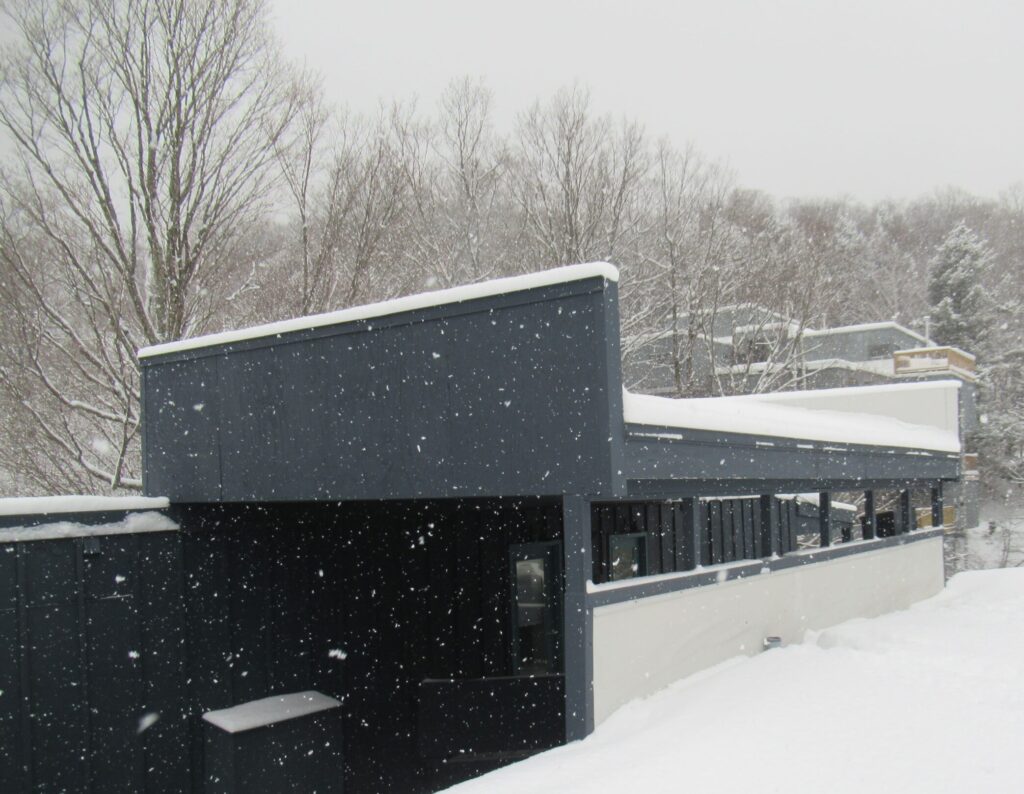
Winter construction in the Northeast is entirely possible, but only if the project team plans in advance. Across New England and New York, overnight lows are already dipping into the 30s, and most of the building envelope repair work we oversee is temperature-sensitive: concrete, mortar, stucco, EIFS, sealants, roofing adhesives, and liquid-applied waterproofing all have minimum installation temperatures, and most of them are vulnerable to freezing before they cure.
The good news is that the industry standards are clear about what “cold” means and what protection is required. The less-good news is that compliance costs money: enclosures, heat, insulated blankets, accelerated mixes, temperature monitoring, and slower production. This article summarizes what the governing standards actually require for each material, so owners and property managers can make an informed decision about whether to push work through the winter, phase it, or wait for spring.
The 40°F rule of thumb
For nearly every material discussed below, 40°F is where cold weather procedures begin. American Concrete Institute (ACI) 306R-16 defines cold weather as air temperature that has fallen to, or is expected to fall below, 40°F during the protection period, and the masonry specification (TMS 602, formerly ACI 530.1) uses the same 40°F trigger for its cold weather requirements. Stucco, EIFS, and most sealant and coating manufacturers publish 40°F as a minimum application and curing temperature as well.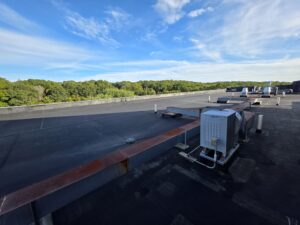
The reason is chemistry. Portland cement hydration slows dramatically as temperatures fall, and the water in fresh concrete, mortar, or plaster expands roughly 9 percent when it freezes. If that happens before the material has gained enough strength to resist the expansion, the damage is permanent. ACI 306R-16 identifies about 500 psi as the threshold: concrete protected from freezing until it reaches roughly that strength can survive a single freeze-thaw cycle, and well-proportioned mixes held at 50°F typically get there within about 48 hours. Concrete that will see repeated freezing and thawing while saturated needs more, on the order of 3,500 psi, before protection is removed.
There are two practical points follow from this. First, the critical number is the temperature of the material, not the forecast high for the day; ACI 306R-16 emphasizes that surface temperature, especially at corners and edges, is what determines whether protection is working. Second, the most dangerous period is not mid-January, when everyone expects to protect the work, but late fall and early spring, when a mild afternoon placement is followed by an unexpected hard freeze overnight. ACI 306R-16 recommends protecting all fresh concrete from unexpected freezing for at least the first 24 hours, even outside the defined cold weather season.
Concrete
ACI 318-19 (Section 26.5.4) requires adequate equipment on site to heat materials and protect concrete in freezing or near-freezing weather, prohibits frozen materials, and requires forms, fillers, and ground in contact with concrete to be free of frost and ice. ACI 306R-16 then recommends minimum concrete temperatures based on the thinnest dimension of the element, because thin sections lose heat fastest.
| Minimum section dimension | Minimum concrete temperature as placed and maintained | Maximum gradual temperature drop in first 24 hr after protection ends |
| Less than 12 in. | 55°F | 50°F |
| 12 to 36 in. | 50°F | 40°F |
| 36 to 72 in. | 45°F | 30°F |
| Over 72 in. | 40°F | 20°F |
Source: ACI 306R-16, Table 5.1. Placement temperature should not exceed these minimums by more than 20°F; hotter concrete loses slump faster, sets unevenly, and cracks more.
Most of the work our clients undertake (elevated slabs, toppings, balconies, parking deck repairs) falls in the thinnest category. Key recommendations from ACI 306R-16 and NRMCA’s Concrete in Practice sheet CIP 27 include:
- No placing on frozen ground or icy forms. Thaw and recompact frozen subgrade, then insulate it. Reinforcing bars generally do not need heating unless air temperature is below 10°F, but large steel embedments (over 4 sq. in. in cross-section) should be warmed above 32°F.
- Protection period. Hold the concrete at the Table 5.1 temperature for at least 2 days for unloaded elements not exposed to freeze-thaw, 3 days if exposed, and 6 days if partially loaded and exposed (roughly one-third less with accelerated mixes). Structural elements that carry shores or construction loads should come out of protection based on measured in-place strength, not the calendar.
- Measure in-place strength properly. ACI 306R-16 recommends maturity testing (ASTM C1074) or in-place methods such as pullout or penetration testing, and advises against relying on field-cured cylinders in cold weather because they rarely match the structure’s temperature history. (NRMCA’s CIP 27 still lists field-cured cylinders as an option, so align the specification and testing agency before the first pour.)
- Accelerators help but do not prevent freezing. Type C and E accelerators shorten set time and the protection period, but conventional accelerators lower the freezing point of mix water by only about 4°F. Calcium chloride is effective but promotes corrosion of reinforcing; NRMCA caps it at 2 percent by weight of cement and recommends non-chloride accelerators for prestressed concrete or wherever corrosion is a concern, which in a parking structure is everywhere. Cold weather admixture systems meeting ASTM C1622 are tested for concrete reaching 23°F after placement, but they are a specialty tool, not a substitute for a plan.
- Cure without water. Water curing is not recommended when freezing is possible because it leaves the surface saturated when protection comes off. Use curing compounds, impervious sheeting, or blankets.
- Remove protection gradually. The surface should cool no faster than the Line 5 limits in the table above. NRMCA notes thermal cracking can occur when surface-to-core differences exceed about 35°F.
- Document temperatures. Record surface temperatures, especially at corners and edges, at least twice per 24 hours. If protection is pulled temporarily, ACI 306R-16 recommends making up twice the lost degree-hours before ending protection.
- Keep acceptance cylinders warm. Per ASTM C31, standard-cured cylinders should be held at 60 to 80°F for their first 24 to 48 hours on site. Cold cylinders produce low breaks and arguments.
One contractual wrinkle worth checking: many project specifications still incorporate ACI 306.1-90, a mandatory specification with an older definition of cold weather (a period of more than three consecutive days with average daily temperature below 40°F), while ACI 306R-16 is a guide and is not enforceable unless restated in the contract. ACI itself has noted that this mismatch can lead to disputes, recommends that specifiers adopt the ACI 306R-16 definition explicitly, and has indicated that a revised ACI 306.1 aligned with the guide was expected in 2026. Until project documents catch up, owners and design professionals should confirm which document governs before the season starts, and contractors who find the older definition in a specification should resolve it by RFI.
Concrete repair
Repair work is harder to protect than new construction because the placements are thin and the substrate is a large. A 2-inch patch on a parking deck behaves like the “less than 12 in.” row in the table above, and the existing slab will pull heat out of it from below. ACI 546R, the Concrete Repair Guide, flags several winter-specific issues:
- Know the material’s temperature window. Latex-modified concrete overlays, common on parking decks, should be placed and cured between 45 and 85°F. Silica fume concrete calls for a minimum curing temperature of 40°F. Most proprietary repair mortars publish similar minimums for both air and substrate temperature, and those minimums govern.
- Some materials are built for the cold. Magnesium phosphate mortars generate their own heat and, per ACI 546R-04, can be placed at temperatures as low as 0°F with heated water and materials, reaching about 6,000 psi within 48 hours. Rapid-setting cements also perform at low temperatures; ACI 306R-16 cites strengths of 1,700 to over 8,000 psi after 24 hours of curing at 20°F. These products are useful for emergency patches and anchorage, though they have their own limitations (MPC, for example, should not be used with carbonate aggregates).
- Crack injection usually waits. ACI 546R-04 notes that most crack repair materials cannot be installed much below 40°F. Winter is, however, the ideal time to survey active cracks: thermal cracks are at their widest in cold weather, so mapping them now makes for a better repair scope in spring.
- Sealers and coatings need time and warmth. ACI 546R recommends that concrete repairs cure at least 28 days before most surface treatments are applied, and its summary table lists many coating systems at roughly 50°F or above. A deck repaired in December may not be ready for a traffic membrane until spring regardless of the weather.
- Keep deicers off fresh concrete. Newly placed concrete and deicing chemicals are simply not compatible. Property managers should coordinate snow-removal contracts with repair areas, especially in garages.
For most owners, the practical takeaway is to complete exposed, thin-section repairs and coatings before Thanksgiving where possible, and to schedule surveys, design, and bidding over the winter so crews can mobilize when temperatures cooperate.
Masonry
Unlike the ACI concrete guide, masonry cold weather provisions are written as code. The International Building Code, the model for both the Massachusetts and New York City building codes, requires masonry to comply with TMS 602, Specification for Masonry Structures (published jointly with ACI as ACI 530.1 in earlier editions). As the specification commentary puts it, the provisions apply whether or not the contractor submitted a cold weather plan, and the plan becomes mandatory once air or unit temperatures drop below 40°F. The Brick Industry Association’s Technical Note 1 summarizes the requirements, which tighten in steps:
| Temperature | During construction (based on ambient air) | After construction (based on mean daily temperature) |
| 40 to 32°F | Heat sand or water so mortar is 40 to 120°F when mixed; do not heat materials above 140°F; heat grout materials if below 32°F | Cover new masonry with a weather-resistive membrane for 24 hours |
| 32 to 25°F | Keep mortar above freezing until used; grout 70 to 120°F when mixed and above 70°F when placed | Same as above |
| 25 to 20°F | Heat masonry surfaces on both sides to 40°F; windbreaks or enclosures when wind exceeds 15 mph; heat masonry to 40°F before grouting | Insulating blankets for 24 hours (48 hours for grouted masonry unless grout uses only Type III cement) |
| Below 20°F | Enclosure with auxiliary heat to keep air above 32°F | Keep masonry above 32°F for 24 hours (48 hours if grouted) with heated enclosures, heating blankets, or infrared lamps |
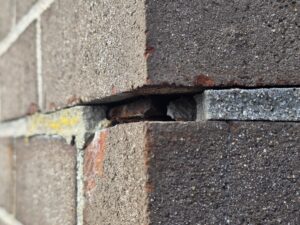 At every temperature below 40°F, units colder than 20°F or carrying ice or snow may not be laid, and ice and snow must be removed from the work below and the surface warmed above freezing. Glass unit masonry may not be laid at all below 40°F.
A few points from BIA Technical Note 1 are worth emphasizing for owners reviewing contractor submittals:
- BIA advises against antifreeze admixtures outright, noting that most commercial mortar “antifreeze” products are really accelerators, and that dosing them high enough to depress the freezing point significantly reduces compressive and bond strength. Calcium chloride is not recommended because it corrodes ties, anchors, and reinforcement, and the TMS Code limits admixtures to 0.2 percent chloride ions in mortar.
- Non-chloride accelerators may be acceptable if approved, but the masonry still has to be protected from freezing.
- Covers should be secured and extend at least 2 feet down each side of the wall. Wet, uncovered wall cavities that freeze are a common source of efflorescence and early mortar deterioration.
- BIA recommends water-based cleaning only when the temperature will be 40°F or above and stay there until the brickwork dries.
Much of the masonry work on existing buildings in Boston and New York is repointing and unit replacement, often with lime-rich mortars that gain strength slowly. The U.S. General Services Administration’s historic preservation procedures limit repointing with lime mortar to temperatures between 40 and 80°F, and its terra cotta procedures require temperatures in that range to persist for 48 hours after the work. Mortar manufacturers commonly call for protecting lime-based pointing mortars from freezing for two weeks or more after installation. In practice, we generally advise owners to treat repointing and terra cotta repair as three-season work rather than attempt it under winter enclosures.
Stucco and EIFS
Stucco and EIFS share a vulnerability: they are applied in thin coats with very little thermal mass, often over a cold, massive substrate that draws heat out of them.
Portland cement stucco. The International Building Code (Section 2512.4) requires cement plaster to be applied when the ambient temperature is above 40°F, unless provisions are made to keep the plaster above 40°F during application and for 48 hours afterward. ASTM C926, the application standard the code references, adds that plaster may not be applied to a frozen base or one containing frost, and must be protected from freezing for at least 24 hours after set. Manufacturers’ data sheets generally go further, telling applicators not to start if temperatures are expected to drop below 40°F within the following 24 hours. As Walls & Ceilings has explained, the 40°F limit is less about the plaster freezing immediately and more about preserving a reasonable set time with a margin of safety above freezing.
EIFS. EIFS base coats, finishes, and most liquid-applied water-resistive barriers are water-based acrylic or polymer-modified products that cure by evaporation. The EIFS Industry Members Association’s (EIMA) 2025 technical bulletin on cold and hot weather installation notes that low temperatures dramatically slow drying, and that if the water in the coatings freezes before curing, the cure is permanently disrupted. Manufacturers typically require surface and ambient temperatures of 40°F and rising during application and for a period afterward; evaluation reports for common systems specify at least 24 hours above 40°F after application. Unlike portland cement products, acrylic coatings that freeze or dry improperly cannot simply be re-wetted to resume curing.
EIMA’s bulletin offers three practical cautions for heated enclosures that apply equally to stucco:
- Tarped, heated enclosures trap humidity, which further slows evaporative curing.
- Choose the heater carefully. Direct gas-fired heaters add water vapor and combustion by-products to the enclosure; EIMA recommends electric or indirect-fired heaters. Trade guidance also warns against kerosene heaters, whose soot can contaminate acrylic finishes.
- Heat the whole assembly. If only the exterior face is heated and the back of the wall stays cold, curing and adhesion will be inconsistent.
For owners, winter stucco and EIFS work is achievable only inside a full, heated, ventilated enclosure, with substrate temperatures checked with a contact thermometer before each day’s work, not just the air temperature on a phone app.
Roofing
For roofing and waterproofing, the enemy in winter is moisture as much as cold. Membranes can be installed in remarkably low temperatures, but the adhesives, primers, and liquid-applied products that hold them down and seal them are far less forgiving.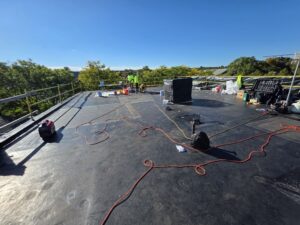
In a Professional Roofing column on cold weather application, NRCA notes that most manufacturers limit water-based and low-VOC adhesives to rooftop temperatures of 40°F and rising, recommend storing them between 60 and 90°F, and generally recognize that newly applied adhesives should not freeze until at least two days after application. NRCA’s Cold Weather Application Task Force also flagged “adhesive blushing,” in which evaporative cooling drops the substrate below the dew point and condensation forms within the adhesive, weakening the bond. The task force suggests limiting water-based and low-VOC adhesive application to times when the dew point is at least 5°F, and preferably 10°F or more, below the ambient temperature. In practice that often means a working window from late morning to mid-afternoon.
For hot-applied built-up and modified bitumen roofing below 40°F, NRCA and manufacturers recommend shortening the distance between the kettle and the point of application and using insulated equipment so the bitumen stays at its application temperature. The Asphalt Roofing Manufacturers Association advises that each roof section be completed and sealed daily in cold weather, and that work stop if proper application temperatures cannot be maintained. Manufacturer literature rates some self-adhered single-ply systems for installation at 20°F, and NRCA recommends owners and designers consider specifying less temperature-sensitive systems when sequencing forces roofing into late fall or winter. Temporary roofs are another option when interior work must proceed.
For sealant installation the risk is frost. As substrates approach freezing, a thin layer of frost can form that is nearly invisible but prevents adhesion. ASTM C1193, the standard guide for joint sealants, addresses cold weather installation, and manufacturers that permit lower-temperature work place the burden on the installer to keep joints clean, dry, and frost-free. Cure also slows substantially; one major manufacturer’s rule of thumb is an extra day of cure for every 10°F drop in temperature. Field adhesion pull tests per ASTM C1193 are cheap insurance for any sealant installed between November and March.
Plaza deck membranes, parking deck traffic coatings, and fluid-applied air and water barriers typically carry 40°F minimums for both air and substrate, dew point limits similar to roofing adhesives, and moisture limits for the concrete beneath. A slab that is above freezing at noon can still carry frost or condensation from the night before. On the parking structures we evaluate, traffic coating work is almost always better deferred to spring than forced under tarps.
Heat safely
Every material above relies on enclosures and temporary heat once temperatures fall far enough, and that equipment brings its own risks to the building and the people in it.
- Unvented direct-fired heaters (salamanders and torpedo heaters) discharge carbon dioxide and carbon monoxide into the enclosure. ACI 306R-16 warns that CO2 reacts with fresh concrete surfaces to form a soft, chalky layer that dusts for the life of the slab, and that CO accumulation endangers workers. Indirect-fired, hydronic, or electric heat avoids both problems and is also what EIMA recommends for EIFS.
- OSHA’s construction standard for temporary heating devices (29 CFR 1926.154) requires sufficient fresh air for proper combustion and worker health, mandates clearances to combustible materials, and prohibits solid-fuel salamanders in buildings and on scaffolds. OSHA has also interpreted the related ANSI A10.10 standard to call for CO testing in enclosed or partially enclosed spaces within an hour of each shift’s start and at least every four hours thereafter.
- Tarps, foam insulation, and fuel in close proximity are a combustible combination. ACI 306R-16 notes that fire can destroy an enclosure and damage the concrete it was protecting.
Build or wait? A planning checklist for owners
The decision to work through winter is ultimately an economic one. Cold weather work adds cost through lower productivity, blankets, tarps, and heaters, but may keep a project on schedule, and the owner should decide whether that premium is a good investment or whether waiting for milder weather is more cost-effective.
If you are considering winter work, we recommend the following, ideally before the end of November:
- Decide what truly needs to happen this winter. Emergency repairs, work that keeps a building watertight, and work on a fixed regulatory deadline (such as façade inspection cycles in Boston and New York) may justify the premium. Cosmetic and non-critical work usually does not.
- Hold a preconstruction meeting on cold weather. Wwner, design professional, contractor, material suppliers, and testing agency agree on methods before the season starts.
- Require a written cold weather plan as a submittal. It should identify enclosure and heating methods, heater types and venting, insulation, temperature monitoring locations and frequency, and the stop-work criteria for each material.
- Confirm which standards govern.
- Plan strength verification. Agree in advance on maturity sensors or in-place testing for concrete, and make sure acceptance cylinders will be kept warm on site.
- Stage materials and equipment early. Blankets, tarps, heaters, and heated storage need to be on site before the first hard freeze, not ordered after it.
- Budget for time as well as equipment. Slower set, longer cure, and weather days all extend schedules. A contractor bid that assumes summer production rates in January deserves a second look.
Use the winter for what it does best. Surveys, crack mapping, design, permitting, and bidding all proceed regardless of temperature, and a project that is fully designed and contracted by March is the one that mobilizes first in spring.
Kevin M. Duffy
Principal
Duffy Engineering